Business Sandesh Indian Newspaper | Articles | Opinion Pieces | Research Studies | Findings & News | Sandesh News
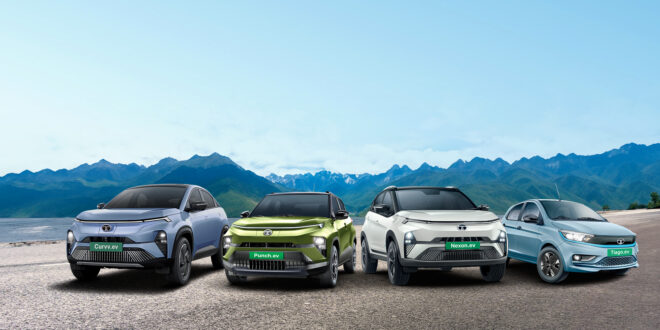
Tata Motors: Defending the Pole Position
The automaker’s competitive edge is bolstered by leveraging its ownership of the luxury automotive brand Jaguar Land Rover (JLR). Tata Motors integrates advanced AI-driven technology and high-end engineering insights from JLR into its electric offerings. This approach enables Tata to offer premium-feeling, technology-rich EVs at mass-market prices, appealing directly to a price-sensitive yet aspirational Indian consumer base.
A crucial aspect of Tata’s dominance lies in its well-developed ecosystem integration. By harnessing the strengths of sister companies like Tata Power for widespread charging infrastructure and Tata Chemicals for battery technology, Tata Motors creates a seamless EV experience for consumers. The company’s holistic approach addresses the critical issue of “range anxiety” and convenience, significantly boosting consumer confidence.
Moreover, Tata Motors recently marked its strategic entry into the premium EV segment with the Harrier EV AWD. Equipped with advanced features such as dual-motor AWD, a range exceeding 500 km, and Level 2 Advanced Driver Assistance Systems (ADAS), the Harrier EV signals Tata’s intent to dominate not just the affordable segment but also the premium EV space.
Mahindra: Rising Challenger
Mahindra’s future EV portfolio, including upcoming models such as XEV7E, is designed explicitly to appeal to premium consumers. The XEV7E, expected soon, aims directly at Tata’s Harrier EV by featuring a powerful dual-motor AWD setup with an impressive combined output of approximately 310–325 BHP. The model is expected to provide an outstanding range between 550–600 km per charge, coupled with ultra-fast charging capabilities, presenting a serious competitive threat.
Mahindra’s strategic advantage stems significantly from its extensive investments in research and development, notably the INGLO modular EV platform. This scalable platform is engineered for enhanced efficiency and superior battery performance, offering flexibility in vehicle size, battery range, and performance—key to competing in diverse market segments.
Additionally, Mahindra has strategically partnered with global leaders such as BYD for advanced battery technologies, ensuring their EV models possess high battery longevity, excellent performance, and long-range capabilities.
Mahindra’s international design studio, Mahindra Advanced Design Europe (MADE) in the UK, further underscores its global ambitions. Vehicles like the XUV700 and Scorpio-N illustrate Mahindra’s potential to appeal to international markets, and leveraging this global experience could substantially enhance Mahindra’s positioning in India’s EV race.
However, Mahindra faces the critical challenge of appealing broadly enough to gain meaningful volume market share. Unlike Tata, Mahindra’s premium-oriented strategy inherently limits its mass-market appeal, raising strategic questions about its ability to challenge Tata’s dominant position comprehensively.
Tesla’s Entry Signals a Shift
After years of anticipation, Tesla officially entered the Indian market on July 15, 2025, with the launch of its first showroom in Mumbai’s Bandra Kurla Complex (BKC). This move is backed by India’s 2024 EV policy, which reduces import duties to 15% for fully built electric vehicles priced above $35,000 ex-factory (approximately ₹30 lakh), provided manufacturers commit at least $500 million toward local production within three years. While Tesla has not yet committed to manufacturing, it has begun building a local presence—recruiting for roles in sales, service, and supply chain across Mumbai, Pune, and Bengaluru, and importing Supercharger equipment to begin establishing its charging infrastructure.
Currently focused on market testing, Tesla is offering imported models such as the Model Y, priced between ₹59.89 lakh and ₹68 lakh—placing it well above the average Indian car buyer’s budget, which typically stays under ₹20 lakh. This price gap, combined with limited initial infrastructure (just eight Superchargers planned), and competition from players like JSW MG Motor (up to 38% market share) and Mahindra (15%), poses serious challenges. While Tesla brings global prestige and cutting-edge technology, including semi-autonomous driving and a 330-400 km range, its long-term success in India will depend on whether it can localize effectively—adapting pricing, product, and service to meet the expectations of a price-sensitive, infrastructure-constrained market.
Limited EV Penetration: EV adoption has grown from 1% in 2019 to about 6–7% today, but remains far from the 2030 target of 30%.
Cost Constraints: High initial costs continue to deter many potential buyers.
Charging Infrastructure Deficit: With only about 12,000 public charging stations nationwide, “range anxiety” remains a major deterrent.
Supply Chain Vulnerability: Heavy reliance on China for rare earth elements and other components presents both economic and geopolitical risks, hindering self-reliance and scalability.
Who Holds the Future?
Tesla’s entry introduces global pressure, performance standards, and heightened consumer expectations. It also intensifies the urgency for all players to evolve faster—technologically, strategically, and operationally.
The Indian EV war is evolving rapidly, marked by opportunity and complexity in equal measure. The next few years will determine whether Tata can hold its ground, Mahindra can expand its reach, or Tesla can leapfrog both by redefining the very rules of the game.