Business Sandesh Indian Newspaper | Articles | Opinion Pieces | Research Studies | Findings & News | Sandesh News
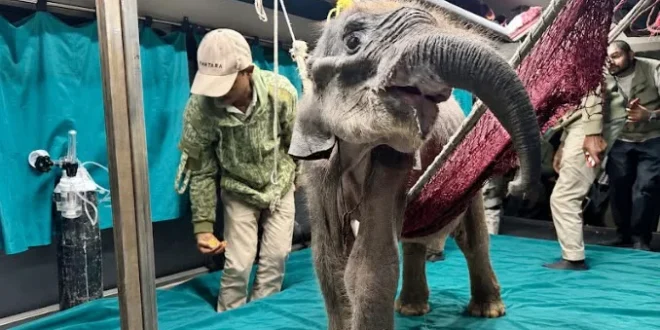
Jamnagar: Seven-week-old Asian elephant calf Raja, who has been battling serious health complications since birth, was successfully airlifted from Assam to Vantara’s specialised elephant hospital in Jamnagar, Gujarat, on November 20, 2026. The emergency medical transfer, facilitated by Anant Ambani, Founder of Vantara, enabled the fragile calf to reach advanced veterinary care without undertaking a road journey of more than 2,500 km.
Providing an encouraging update on November 21, the Assam government said Raja was feeding well and responding positively to treatment at Vantara’s Jamnagar facility. He has been admitted to an intensive care-like environment, where veterinary specialists are concentrating on improving his immunity through nutritional support and specially formulated milk replacement. The medical team is also monitoring his fractured leg and ongoing infections.
The airlift was arranged after Raja’s medical condition reached a stage where intensive hospitalisation became necessary. For nearly seven weeks, the Vantara veterinary team had provided treatment and round-the-clock care at his owner’s residence in Pohumara, Assam. However, his multiple health complications required advanced diagnostic facilities, specialist orthopaedic care and a structured rehabilitation programme.
The operation marks the third such emergency animal airlift in India facilitated by Anant Ambani, according to Vantara. A specially designed aircraft and a dedicated veterinary team ensured that the calf could be transported under continuous medical supervision.
A difficult beginning
Raja was born on October 2, 2026, in Gogamukh, Assam, to an 11-year-old elephant. Following the birth, his mother became frightened and accidentally kicked the newborn, resulting in a complete fracture of his right femur, the thigh bone of his hind leg.
The injury prevented Raja from standing or bearing weight on the affected leg. He was also unable to receive his mother’s colostrum and milk, which provide essential nourishment and immunity to newborn elephants.
Recognising the seriousness of his condition, Raja’s owner and caregivers sought specialised veterinary assistance from Vantara. Its Rapid Response Team reached him on October 8, 2026, and initial X-rays confirmed a complete overriding fracture, in which the broken ends of the bone had moved out of alignment.
The veterinary team stabilised the injured limb with a plaster cast and supportive bandaging. A sling was also used to help him stand and reduce pressure on the injured leg. Since he could not receive his mother’s milk, specialists introduced a specially formulated milk replacement and provided feeding bottles and guidance to his caregivers.
On October 10, Raja was moved to his owner’s residence in Pohumara, where the Vantara team continued treatment and monitoring. A hydrotherapy pond was also constructed near his resting area to enable him to move and strengthen his body without putting weight on the fractured limb.
Multiple health complications made hospitalisation necessary
Despite sustained treatment, Raja developed several additional health complications. He suffered from diarrhoea, and laboratory investigations detected a Klebsiella pneumoniae bacterial infection. He also experienced recurrent episodes of low blood sugar, elevated liver markers, pressure sores on his head, an umbilical hernia and general physical weakness.
The veterinary team provided targeted antibiotics, intravenous fluids, liver support, vitamins, minerals, probiotics, wound care and nutritional support. However, his weakened immunity and the absence of maternal colostrum continued to make his recovery challenging.
According to the medical update shared by the Assam government on November 21, the fracture was showing encouraging signs of healing, although diarrhoea and infection-related concerns continued to require close attention.
Specially arranged flight ensured safe transportation
Raja was transported from Guwahati to Jamnagar on November 20 aboard a specially arranged flight. A customised crate was prepared according to his size and medical requirements, with arrangements to keep his injured leg stable and supported. Deep, soft bedding was provided to protect him from pressure-related injuries during take-off, the flight and landing.
A dedicated team of veterinarians, paravets and caregivers accompanied him throughout the journey. His heart rate, breathing, temperature, hydration and blood glucose levels were continuously monitored, with essential medicines, fluids and milk feeds available during the flight.
The approximately four-hour air journey significantly reduced the physical stress and transportation risks that a road journey of several days could have posed to the young calf.
Advanced treatment and rehabilitation at Vantara
Following his arrival, Raja was admitted to Vantara’s specialised elephant hospital for comprehensive diagnostic assessment and continued medical care. His treatment programme includes orthopaedic management, pain control, infection monitoring, mobility therapy and nutritional rehabilitation.
Given the nature of his injury and the complications arising from his weakened immunity, he is expected to require prolonged veterinary supervision and potentially lifelong monitoring. Vantara has expressed its commitment to providing the necessary care.